
Deafblind Awareness Week
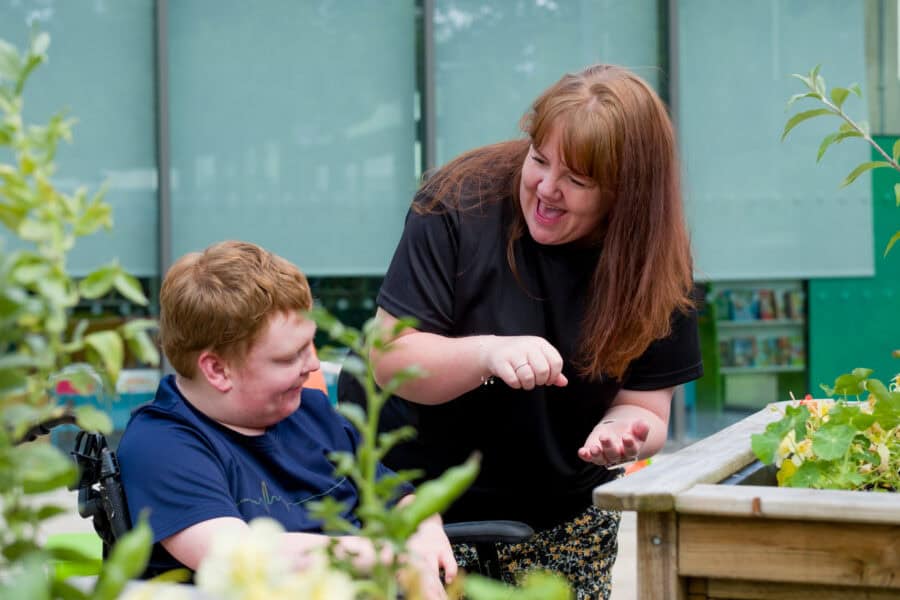
Marking Deafblind Awareness Week in our 70th anniversary year
This year, we’re marking seven decades of supporting disabled people to connect with others and be included in the world.
Sense began 70 years ago when two mothers, Margaret Brock and Peggy Freeman, gave birth to deafblind children, Bunty and Christopher, after contracting rubella during pregnancy.
Both mothers saw the limitless potential in their children, and with no support available, they took matters into their own hands.
They knew there would be other families facing the same challenges as theirs. Through contacts and letters, a group of ten founding families was formed.
This group grew to become the Sense that we are today.
Whilst our history and expertise are deeply rooted in providing support to deafblind people, our reach has grown significantly. We now support over 32,000 disabled with complex needs and their families every year.
What is deafblindness?
Deafblindness is having both sight and hearing loss that affect your everyday life.
Being deafblind doesn’t necessarily mean you are totally deaf and/or totally blind. Most deafblind people have some sight and some hearing.
Some people are born deafblind. This is called congenital deafblindness. Others become deafblind later in life. This is known as acquired deafblindness. Read more about deafblindness in our complete guide.
What can people who are deafblind achieve?
First impressions can be misleading. This Deafblind Awareness Week, let’s challenge misconceptions about how deafblind people watch, play and enjoy sport.
Watch as Franklin, Danielle, Simon, Geordie and Richard enjoy their favourite sports.
This video is narrated by Emma, who is a deafblind campaigner and fundraiser for Sense.
Descriptive transcript for the video
A woman with hearing aids is wearing a jumper that reads ‘Never be afraid to be yourself’. This is Danielle.
A man wearing a black Arsenal football t-shirt sits looking at the ground, this is Richard.
First impressions can be misleading.
A young man sits back in an armchair with his support worker at his side, this is Franklyn.
A man in a hooded coat walks along using a cane to guide him, this is Simon.
A young man with thick glasses watches someone’s hands moving just off-screen, this is Geordie.
You might think people who are deafblind can’t watch football with friends…
Richard sits in front of a televised football game with his back to the camera
can’t play golf…
Simon’s face is screwed up in concentration.
can’t play rounders…
Danielle lowers herself into a seat with support.
can’t play badminton…
Geordie smiles to himself.
can’t rock climb…
Franklyn walks arm in arm with two support workers.
Well… Franklyn can.
Franklyn and his support workers look up at the climbing wall.
Franklyn is up on wall, climbing next to his instructor.
Danielle can.
Danielle swings a rounders bat and hits a ball off a post.
Simon can.
Simon swings a golf club and hits a ball off the green.
Geordie can.
Geordie hits a shuttlecock on a string using a badminton racket
Richard can.
Richard sits in his wheelchair with a group of men. The person next to him uses hand-on-hand signing to converse with him and narrate a football match.
Quick, Man City, wide.
On the climbing wall, Franklyn’s hand reaches up to hold a wall grip. He’s at the very top of the climbing wall with his instructor. His support worker watches from the ground.
Watch as he grabs a hand hold and reaches the top of the climbing wall.
Danielle swings the rounders bat and hits the ball. She’s guided gently past the cones denoting the rounders bases.
Watch as she hits a ball with a bat and walks from base to base.
The golf ball Simon hit rolls into the hole in the green. He smiles at his golf coach and they bump fists.
Watch as he sinks a reflective golf ball in the hole and celebrates with a fist bump.
Geordie waves his badminton racket, hitting the shuttlecock.
Kneeling on the floor, he throws another shuttlecock over a low net, with a coach by his side.
Watch as he hits a shuttlecock with a racket and it flies over a net.
Richard smiles. His communicator guide holds both their hands high and they wave their arms.
Watch as he celebrates a goal.
Sense
sense.org.uk/DBAW
Stories about how deafblind people enjoy sport

How touch unlocks football for Richard, a deafblind fan

Looking up at Franklyn, never down

From language to golf, becoming deafblind hasn’t stopped me learning
Stories challenging misconceptions about deafblind people

People who are deafblind respond to five common myths about deafblindness

As a photographer who is deafblind, I challenge stereotypes every day

My life as a deafblind drag king


Want more inspiring stories like these?

How many deafblind people are there in the UK?
In 2023, there are over 450,000 deafblind people in the UK. This is expected to go up to over 610,000 by 2035.
Find out more about the prevalence of deafblindness in the UK.